My favorite books from 2025
set of 19 books from the year
· 13 min read
I (happily) read quite a bit this year, so I decided to do a review session on everything that I picked up. This was a fun way to see what stuck with me, what was interesting and also to share it out - these are my 19 favorite books this year. Looking back at my reading log, I realized I’d read fairly broadly: books about languages, cities, music, psychology, fiction, history, food (and others). The 19 books I write about here are the ones I learned a lot from or that made me rethink some part of the world. From some I came away with more knowledge, some with a lot of fun facts about a field I knew nothing, and some with new questions. Read on 📕
Invisible Cities - Italo Calvino #
⭐️ “Cities, like dreams, are made of desires and fears, even if the thread of their discourse is secret, their rules are absurd, their perspectives deceitful, and everything conceals something else.” Each brief chapter of this book is the story of an imaginary city. Ersilia is a city where relationships are represented as physical strings connecting households - the invisible social networks are now apparent, ‘physicalized’ in the world. Olinda grows in concentric circles oldest to newest, in Esmeralda people travel in zigzags to not repeat paths they’ve already taken. Inspired by these fantastical cities, I even wrote a short story a few months ago: Drianta (https://deabardhoshi.com/notes/citystory/)
Pachinko - Min Jin Lee #
⭐️ Pachinkos are Japanese gambling arcades, basically like slot machines. This book starts off in a coastal village in South Korea where a young woman called Sunja falls in love with an older, married businessman and, from there, it follows a family through the next century of their lives. The book is both the history of Sunja’s family and a story about Korea in the 20th century.
The Art of Loving - Erich Fromm #
⭐️ This quote from the book itself sums it up perfectly: It wants to convince the reader that all his attempts for love are bound to fail, unless he tries most actively to develop his total personality, so as to achieve a productive orientation; that satisfaction in individual love cannot be attained without the capacity to love one’s neighbor, without true humility, courage, faith and discipline.
Metaphors We Live By - George Lakoff #
⭐️ How do we organize our understanding of the world using metaphors? This book argues that metaphors are a crucial aspect of our conceptual systems: for instance, one common metaphor is ‘arguments are war’ - hence we talk about ‘winning them’. Or we say ‘time is money’ so we talk about ‘spending it well’ or ‘wasting it’. The metaphors that pervade our lives help us understand one phenomenon in terms of another, and thus they also affect how we think and act: if the metaphors were different, would we be acting differently? If they instead focused on different aspects of the thing they are describing, would that affect our understanding?
Language City: The Fight to Preserve Endangered Mother Tongues in New York - Ross Perlin #
⭐️ One of the most fascinating topics I’ve read about: Ross directs the Endangered Language Alliance in New York, a group that tries to document and preserve languages with very low numbers of native speakers. He goes with them all over the world: meeting people in the depths of the Himalayas, or in small language classes in Canada and he describes their individual stories, how they immigrated and how they interact and share their native languages. Most of these languages I had never heard before: Seke, spoken in the Himalayas by Nepali people, Wakhi, in Pakistan, N’Ko, a West African language which needed its own script to be represented in standard keyboards. At the core, the book makes an argument about why linguistic diversity matters - because all of these languages put into words things that no other language does, because each language contains its own knowledge, art and culture, and fundamentally because of a sense of justice.
Living in Data: A Citizen’s Guide to a Better Information Future - Jer Thorp #
⭐️ Jer Thorpe is the artist who designed the name placement on the two 9/11 memorial pools in New York. One of the chapters of his book talks about how he created the placement to put people who knew each-other together by reading about each individual’s records. This is not what you’d typically call a data visualization, but is an example of the kinds of projects Jer finds fascinating. The book discusses many more examples like this, talking about each project as works filled with empathy and joy for creating.
The Image of the City - Kevin Lynch #
⭐️ Urban planning! This book asks the question: “what makes a city imageable, i.e. easy to understand and navigate?” Lynch builds 3 comparative case studies in Boston, LA and Jersey City and asks residents of each to create mental maps and think about how they navigate their cities. Cities like Boston, built early and with pedestrians in mind are much more organic to navigate, whereas places like LA are less ‘imageable’ - in all 3, however, people think of cities in similar lines, as a collection of trajectories, marked by landmarks. Other questions I had from this book were how do people actually form these images? How do personal experiences shape our ideas of cities?
Symphony for the city of the dead: Dmitri Shostakovich and the Siege of Leningrad - MT Anderson #
⭐️ One of my other favorite books from the year! It follows two parallel stories that unfold at the same time: the Siege of Leningrad (now St. Petersburg) by the Nazi regime in 1941 and the writing of Symphony no. 7 by the composer Dimitri Shostakovich. Each of the symphony’s movements is described and explained by not only Shostakovich’s background and the ideas he explored but also using the uniquely difficult context in which it was written.
A Pattern Language - Christopher Alexander #
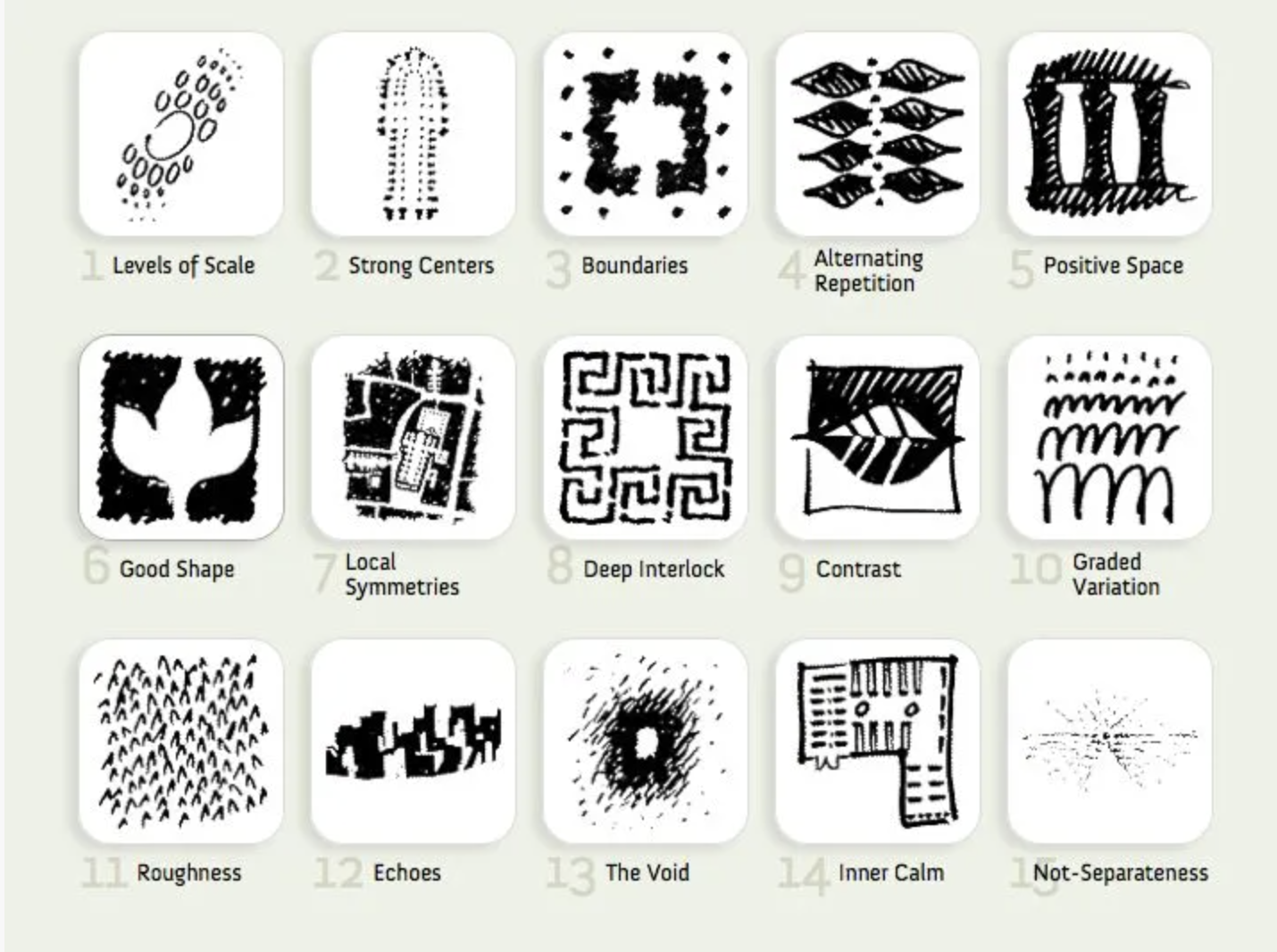
⭐️ This book is an interesting and very ambitious theory on how to build things, from buildings to whole cities. Many things about it are fascinating: for instance, its form. The pattern language is a collection of tree-like ideas: at the most detailed level there are rules such as “four-story limit” (buildings should be 4 stories for cities to feel human-scale), each of those build to bigger ideas “independent regions” (Metropolitan regions will not come to balance until each one is small and autonomous enough to be an independent sphere of culture). Throughout, Alexander raises a few very important and fundamental questions that I’m still thinking about: how do spatial structures affect social lives? What is the optimal size of a city? How to bring all threads of life (work, personal, social lives) together? How to build so that buildings can be customized?
The Ninth: Beethoven and the World in 1824 - Harvey Sachs #
⭐️ Another favorite book about a symphony! This time it’s the famous 9th, which starts from what seems like the end of the world to a culmination of celebrating humanity with the ‘Ode to Joy’. This book also discusses the historical context in which the piece was written and premiered, specifically between the revolutions of 1789, the age of Napoleon and the ensuing wars of the 1830s. I thought this book was a wonderful reflection on how artists are influenced by the problems of the time, and how they influence those events in turn.
The Promise of Happiness - Sara Ahmed #
⭐️ “The question that guides the book is thus not so much “what is happiness?” but rather “what does happiness do?” I am interested in how happiness is associated with some life choices and not others, how happiness is imagined as being what follows a certain kind of being.” Why are only certain life paths deemed as making happiness possible? What are the implications for labor, gender and social roles when we envision happiness only in certain ways (e.g. the happy family, with kids and a dog)? In addition to these key questions, the book also discusses the fraught nature of trying to measure happiness (what makes us happy ≠ what happiness is): when we measure happiness, we are measuring what we value but not necessary what is of value for being happy.
Listening in Paris: A Cultural History - James H. Johnson #
⭐️ This book starts with the seemingly simple question ‘why did audiences in France become silent over the 19th century?’ Starting at the time of the Luises before the revolution, opera audience behaviors were much different than we think of today. For example, it was not customary to arrive at the opera on time, and most people arrived after the first act. Additionally, it was custom to talk over the singers and observe the rest of the people, rather than listen to the performance. The theaters were set such that people could stay in lodges of 6 or so, and the seating was determined by the emperor. The different political events each shaped the opera in their own way. The Red Terror was a period of propaganda and outbursts in the works being performed. People cheered on parts that represented the republic and bashed any mentions of the king. Slowly, audiences began to appreciate music more: it started to have no words, a new type of concertgoer appeared: the dilentantti, people so enraptured by a performance they inhabited it with their whole body. And most importantly, once the Romantic Era started, people were completely fascinated with the Romantic Heroes and the music they produced. Today it’s easy to take the silent audience as a given, but it turned out the history of how these behaviors were created was intriguing to read.
Salt, Fat, Acid, Heat - Samin Nosrat #
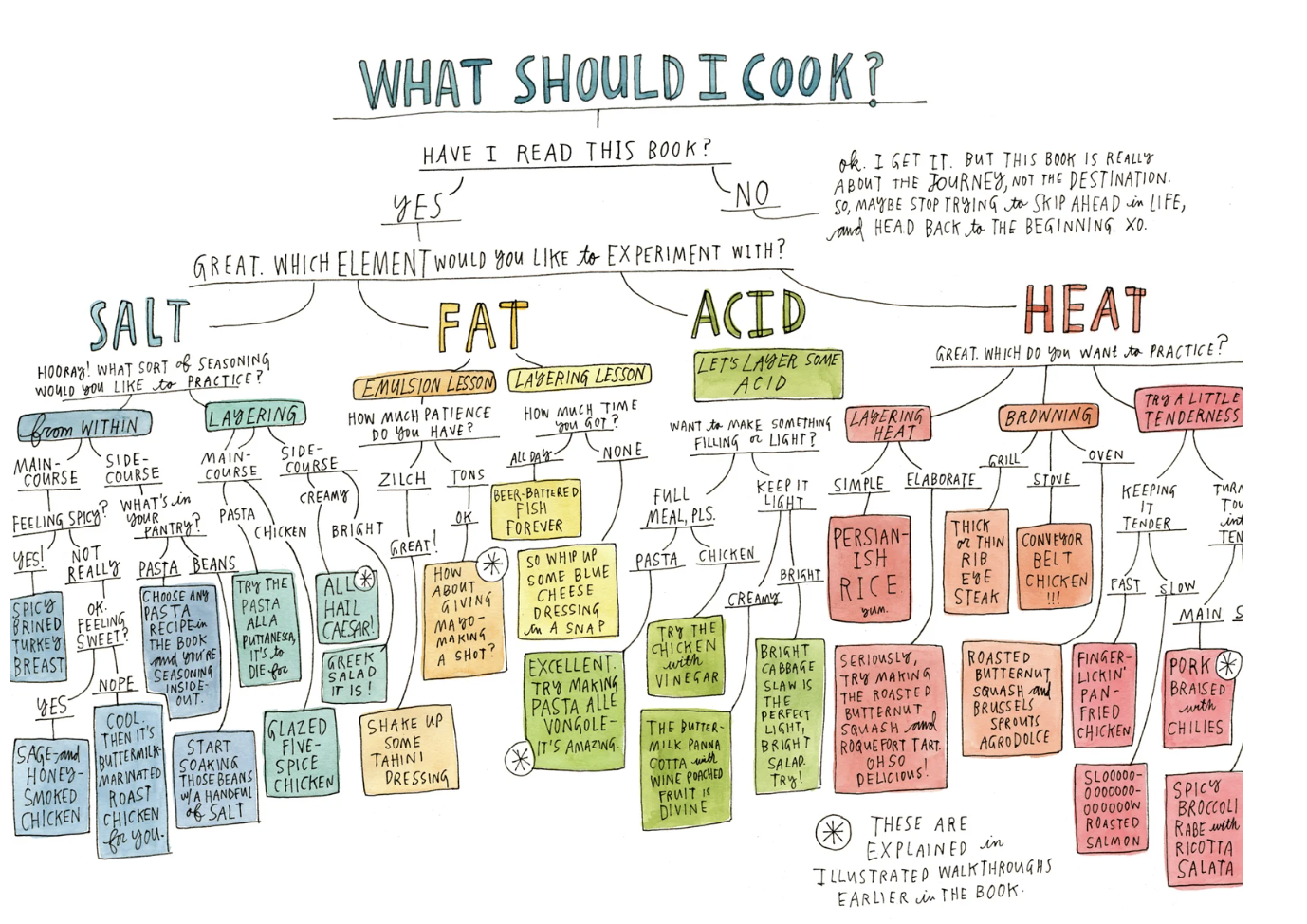
⭐️ This book was delightful to read! It’s a very different kind of cookbook to most. Samin takes the time to talk about the properties of each of the 4 elements of good cooking, going into the chemistry and how the flavors melt together. Then, she talks about specific recipes. I found this concept-based, general rules approach much more productive than recipe-only cookbooks. More importantly, it inspired me to cook more and try out different recipes. Some highlights: emulsions (I finally know why I have to put pasta water to the sauce with the pasta) and adding more salt (salt enhances all flavors, including, unrelatedly to this book, why people add salt to espresso).
In Search of Perfumes - Dominique Roques #
⭐️ I read this book as I became more interested in the history of smells. Each chapter discusses a different element that is used in the perfume industry and it talks about the geography and the people who are involved in harvesting it. For instance, vanilla plant is only produced in Madagascar and the country’s economy is heavily dependent on it. Bergamot is produced in Italy, and its use in perfumes dates back to the 19th century. Frankincense is an extract produced in Somaliland which is not a recognized country. All these essences seem to come from very frail networks, and they are much more connected to global politics than I’d thought.
Hands of Time: A Watchmaker’s History - Rebecca Struthers #
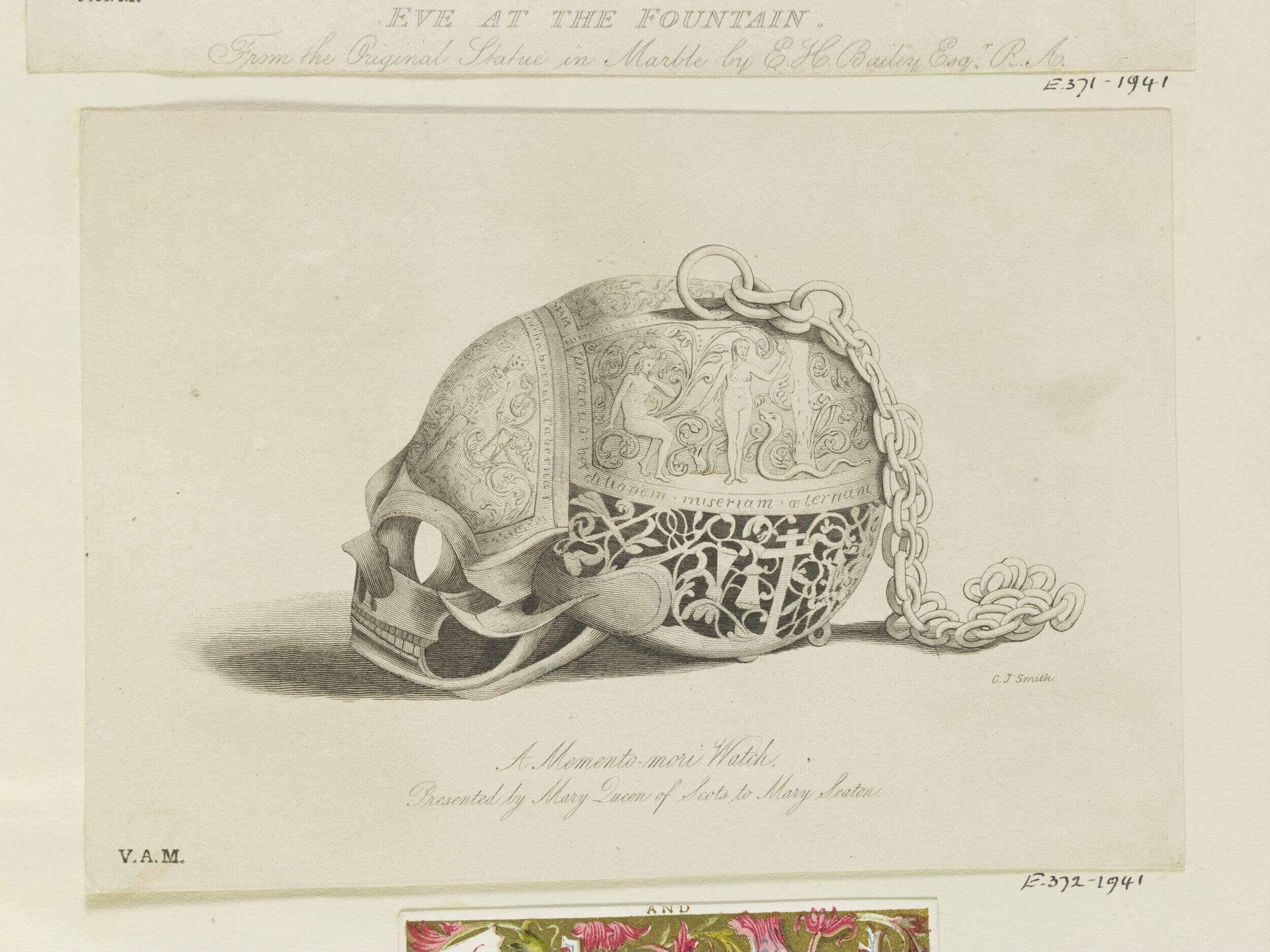
⭐️ I picked up this audiobook on the history of watchmaking as it seemed interesting to learn more about such an intricate and mechanical process. In fact, many rhythms in our lives are governed by time, e.g. menstrual cycles, whereas the first watches were made in Egyptians in 1400 BCE. From there, the history of watches spans water clocks in the Arab Caliphates, the invention of mechanical timekeeping in Europe, watches used for Earth exploration, tracking steps (the earliest pedometers were built in 1770) to atomic and digital watches we use today. It was also interesting to learn of the cultural and political role of the watch: in Revolutionary France, people moved to a decimal based time system as a way to detach themselves from the 60-minute time that the monarchy used.
Absolutely on Music - Haruki Murakami #
⭐️ This book is a series of conversations between Murakami and Seiji Ozawa, the legendary conductor of the Boston Symphony and the Vienna State Opera. They play different recordings and they discuss the differences between performers and the meanings behind all the pieces. For example: ‘In Mahler’s music, though, it feels as though he is deliberately plunging down into the dark, into the subterranean realm of the mind. As if in a dream, you find many motifs that contradict one another, that are in opposition, that refuse to blend and yet are indistinguishable, all joined together almost indiscriminately. I don’t know whether he’s doing this consciously or unconsciously, but it is at least very direct and honest.’
Giovanni’s Room - James Baldwin #
⭐️ One of my criteria for judging if a fiction book is a classic is: do I think about it long after I’ve read it? It hasn’t been that long, but I’ve been thinking about ‘Giovanni’s Room’ since I read it a few months ago. David, the protagonist, is an American who lives in Paris and starts a relationship with Giovanni, an Italian bartender he meets one night. Why David has left America is not discussed, but it seems he ‘wanted to find myself. This is an interesting phrase, not current as far as I know in the language of any other people, which certainly does not mean what it says but betrays a nagging suspicion that something has been misplaced.’ Sometimes you need to step away from the self and the world you are so embedded in to analyze both of them clearly, and other times, truths about your own soul are presented to you in the form of someone else’s self, entirely different from your own.
Keep Going - Austin Kleon #
⭐️ How do you stay creative in hard times? Austin gives us all some tips with his trademark enthusiasm. As his other 2 books, this one is also a joy to read, filled with illustrations from his notebooks and a collage of quotes from the people he admires. There are 10 different pieces of advice, among which he says ‘make gifts’, ‘spend time on something that will outlast you’, but also keep in mind ‘everyday is groundhog day’.
Empires of the Word: a Language History of the World - Nicholas Ostler #
⭐️ This book traces the history of world languages from Sumerian and the Semitic family, to the similarities between Chinese and Egyptian, to Greek and Latin, Sanskrit, and then to contemporary languages we use today. I’ve learned that the story of how language spreads is incredibly complicated, much more so than ‘people who invade bring their language to the new land’. Ostler deals with questions such as what makes a language persist through time, how two languages interact with each-other, how modern languages arise from their ancient versions - a fascinating tale, and told in a very approachable way.
☕️ Dea