Runway Bites
analyzing food offerings in airports
· 6 min read
I love travel: even the airports, even the janky domestic terminals with little seating and no outlets; even sitting down in middle-seat economy for 10 hours - I just find the process of travel thrilling. However, I’ve travelled through multiple American airports and, with the very occassional exception, the food has been consistently disappointing. Why?
So many airports! #
First, some definitions. It turns out that airports in the United States are a small part of aviation facilities, ‘official and operating aerodromes in the United States and territories’. There are around 20,000 such objects:
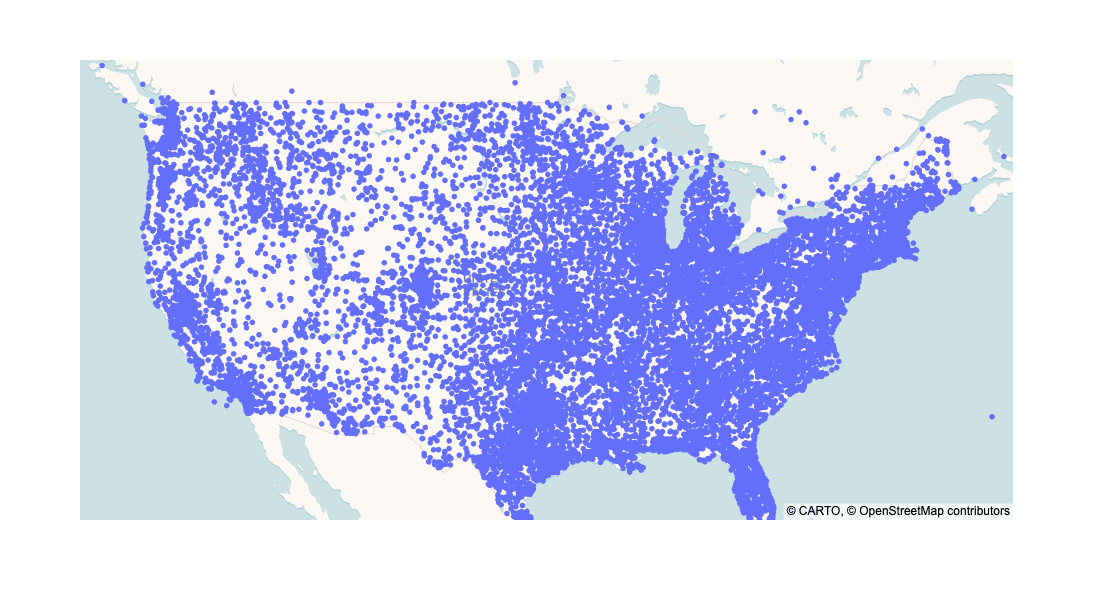
Some of these places are air bases, small heliports or regional airports with limited flying operations. Most of them are in big states, like Texas, Florida and California - in fact, altogether these three have around 3,700 aviation facilities. The commercial airports, however, are the ones that offer eating options; in the United States, around 30-40 of these airports account for a lot of the passenger traffic. Big airports are places like JFK, Dallas Fort-Worth, or O’Hare, which carry millions of people through every year and have tens of restaurants catering to passengers.
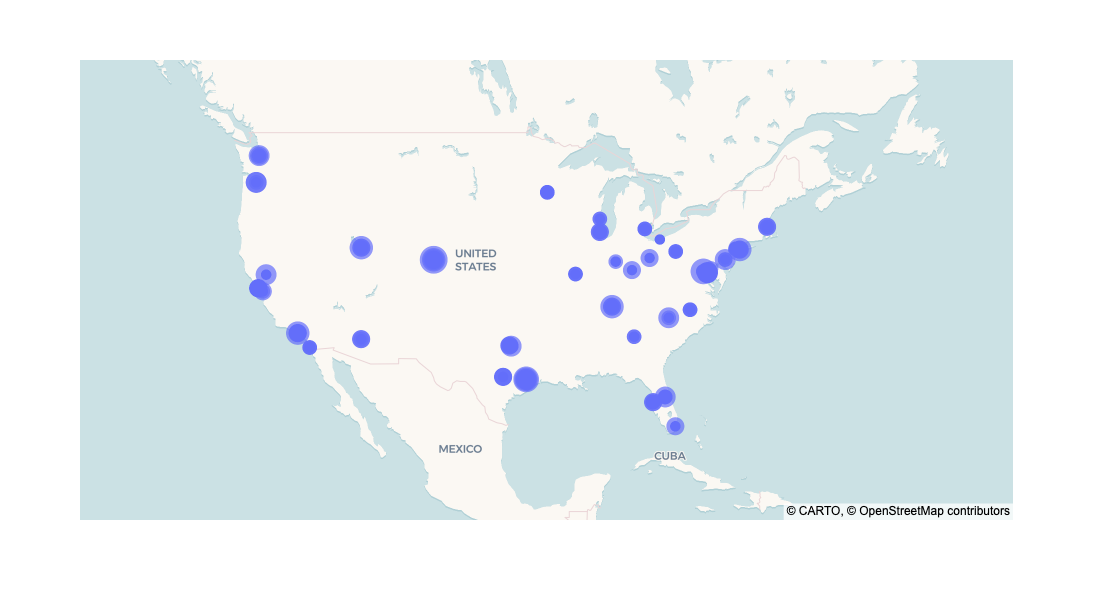
The bigger the airport, in general the more food places it has. Dallas Fort-Worth, bigger than the whole island of Manhattan, has 150 different resturantats. Here are all the ones I was able to get from Google Maps:
Airports, big; food, not good #
These big airports, however, lag behind when it comes to food ratings. Based on Google Maps data for food options within the biggest 30 US airports, JFK, Newark and Los Angeles (LAX) have the lowest average food ratings: a mere 2.5-3 out of 5:
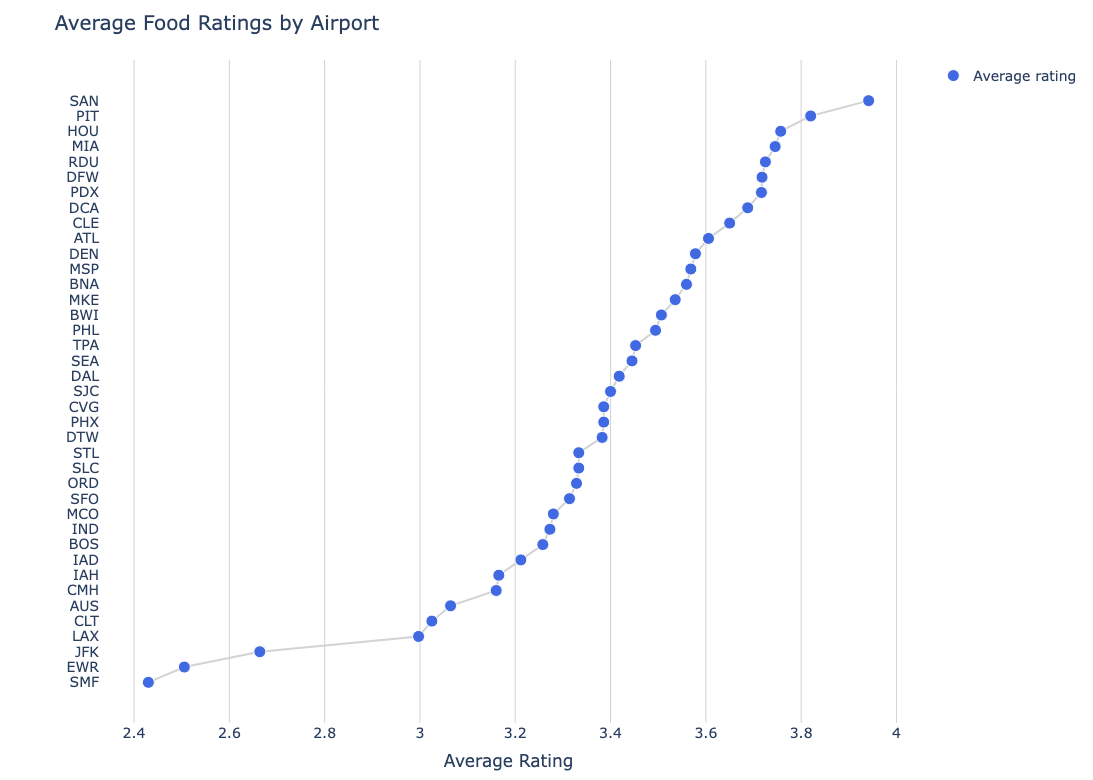
On the other side of the chart, airports in San Diego, Pittsburgh, Houston and Miami have around a 3.8/5 average score. I haven’t personally visited them but from Google Maps data, food in these airports tends to rank pretty well. Miami, for instance, has 2 highly rated and highly reviewed restaurants: La Carreta, a Cuban restaurant with 4,000 reviews and 94th Aero Squadron, an aviation themed restaurant that recalls the 94th squadron which fought in WW1 and were commemorated with 94th Aero Squadrons all over the country.
So what do you need to have a high ranking to get into the foodie top 10 US airports? Have consistently highly ranking restaurants, around a 4 out of 5 like this chart shows:
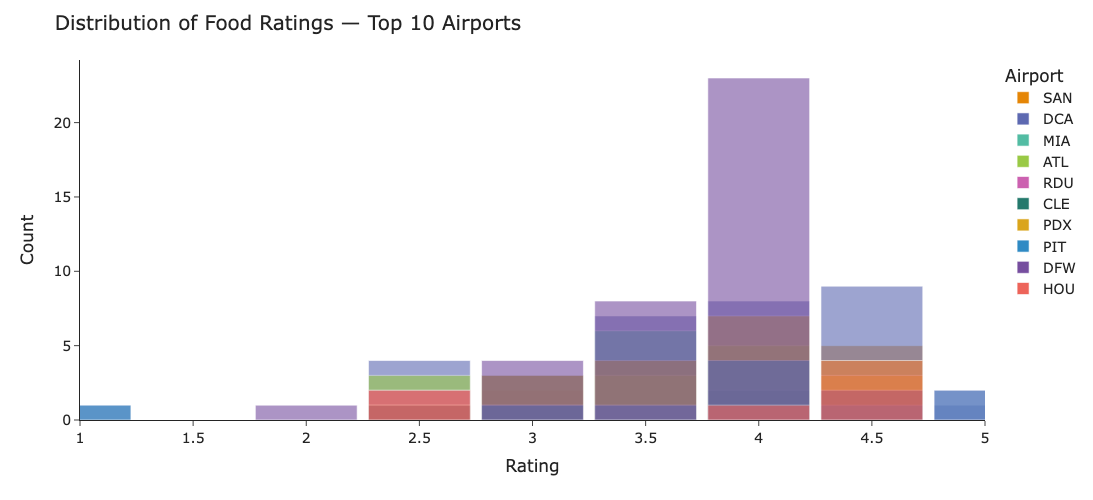
And for somewhere like JFK, to improve on rankings it means having fewer places that rate a 1.5/5 (True Burger Co. 😢). Even some abysmal ratings don’t tell the whole story, however. In terms of the individually highest ranking restaurants, JFK’s Shake Shack on Terminal 8 not only has almost 2,000 reviews but also a score of 4.8! Two other restaurants round out the US-wide top 3: Crawford’s Genuine in Raleigh-Durham, an American Southern-style restaurant open only about one year ago, and Ole Red in Nashville. Ole Red is a fascinating restaurant with live Country music and Southern food, which seems to be a bit of a destination.
Maybe people know where to go and the better restaurants also happen to have more reviews? To a certain extent:
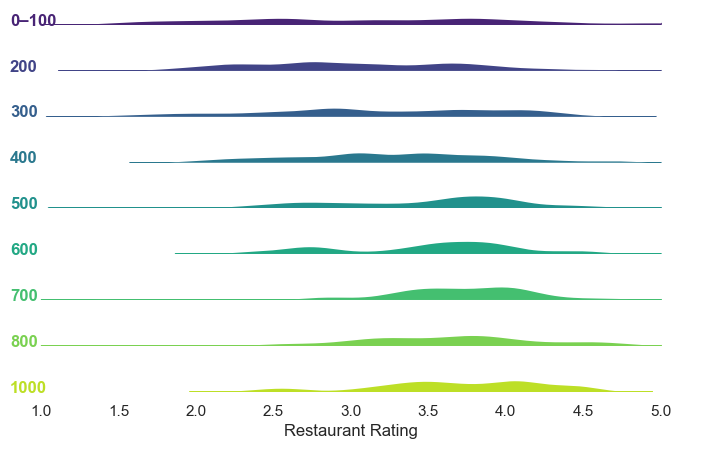
In fact, it does seem like restaurants that are more popular amongst google reviewers are clustered around higher ratings, whereas less reviewed ones are more spread out.
Overall airport ratings & specific airline hubs #
Food is only part of the airport experience; travel time and delays are also a big part. Does a higher ranking in overall ratings also correlate with better food ratings? The FAA publishes on-time performance data for the biggest US airport, and in general there is a positive association between this and average food scores:
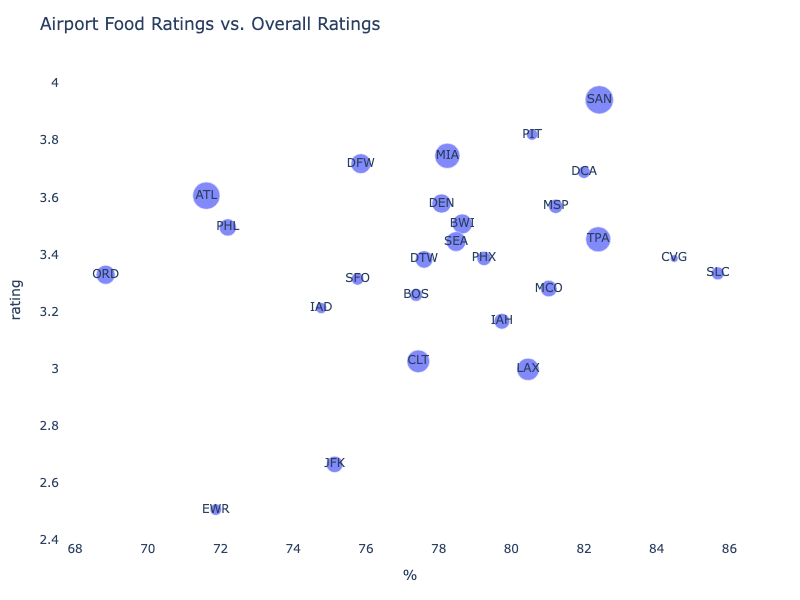
In terms of airline hubs, the 4 biggest US airlines airport centers all rank slightly differently. United (hub at New York EWR) has on average the lowest scores, at just 3.25. On the other hand, Alaska (Seattle SEA, Portland PDX) ranks the highest at 3.71.
How do airport operations work #
The top 3 airport chains are Chick-fil-A, McDonalds’s, and Chili’s - well-established chains even outside of airports. However, there’s one more chain on this list that is not widely known but still seems to have a big airport presence: Half Moon Empanadas - found in 13 airports across the country! This chain is owned by Pilar Guzman who started the business in Miami and has since spread all over the US offering tasty empanadas that can be carried with you as you navigate a terminal. This story, in fact, is an example of how airports contract out competitive space in terminals: airports are first and foremost public entities and the decision for who gets to set up shop in an airport has to be decided like many other public contracts: with RFPs (requests for proposals). Airports put out RFPs for companies to compete for space where they detail like operation plans, prices and business models. Airports have a lot of control over the price as well and they get to enforce a product price of street-price + 10%, which is why things are more expensive at airports. In Half Moon’s case, airports also run programs to support certain businesses, for instance the ACDBE program (Airport Concessions Disadvantaged Business Enterprise) that makes it easier for women and minority-owned businesses to get airport concessionary contracts.
The costs of running these businesses are also incredibly high: there are a lot of constraints on airport businesses that are unique to the field; for example, employees need background checks, they need to come to work really early or really late, everything that goes through to the terminals passes through security and deliveries and logistics are very restricted. Operations at airport restaurants have to be really tight: this employee talks about how their restaurant anticipates flight arrivals and potential delays to adjust how they prepare food.
Brief history nuggets on terminal food #
Commerical airport food goes back to at least the 1940s, where airplane tickets were about 40% more expensive and airports prioritized an elevated eating experience. And people used to go the airports for the culinary experience: National Airport’s Terrace dining room “was a popular destination for Washingtonians in search of fine dining”. Using the airport as a destination for non-travel activities seems extraordinary today, but this was the case for many people in the 40s and 50s who hung out at the airport for leisure and plane-spotting. ‘Dining sky-side’ was a favorite activity at the time: in Newark Joe Baum and Albert Stockli launched The Newarker, which would then lead to many other top restaurants across New York. The Newarker featured “flaming sword specialties, authentic East Indian curries, and regional Swiss specialties”! While it exists no more, it seems like airport restaurants are emerging again: new gourmet options have now popped up across the US.
While I look forward to trying new places, my personal favorite remains the glorious Tortas Frontera, in O’Hare Terminal 1.
Thanks for reading! 🥪